Time-optimal time scaling
●Finding a time scaling that minimizes the time of motion $s(t)$ respecting the given path and the joint's torque limit.
●Of course it satisfies $s \in [0,1], s(0)=0, s(T)=1, \dot{s}(0)=\dot{s}(T)=0$ and $s(t)$ should be monotonically increasing.
Path-constrained inverse dynamics (My own explanation)
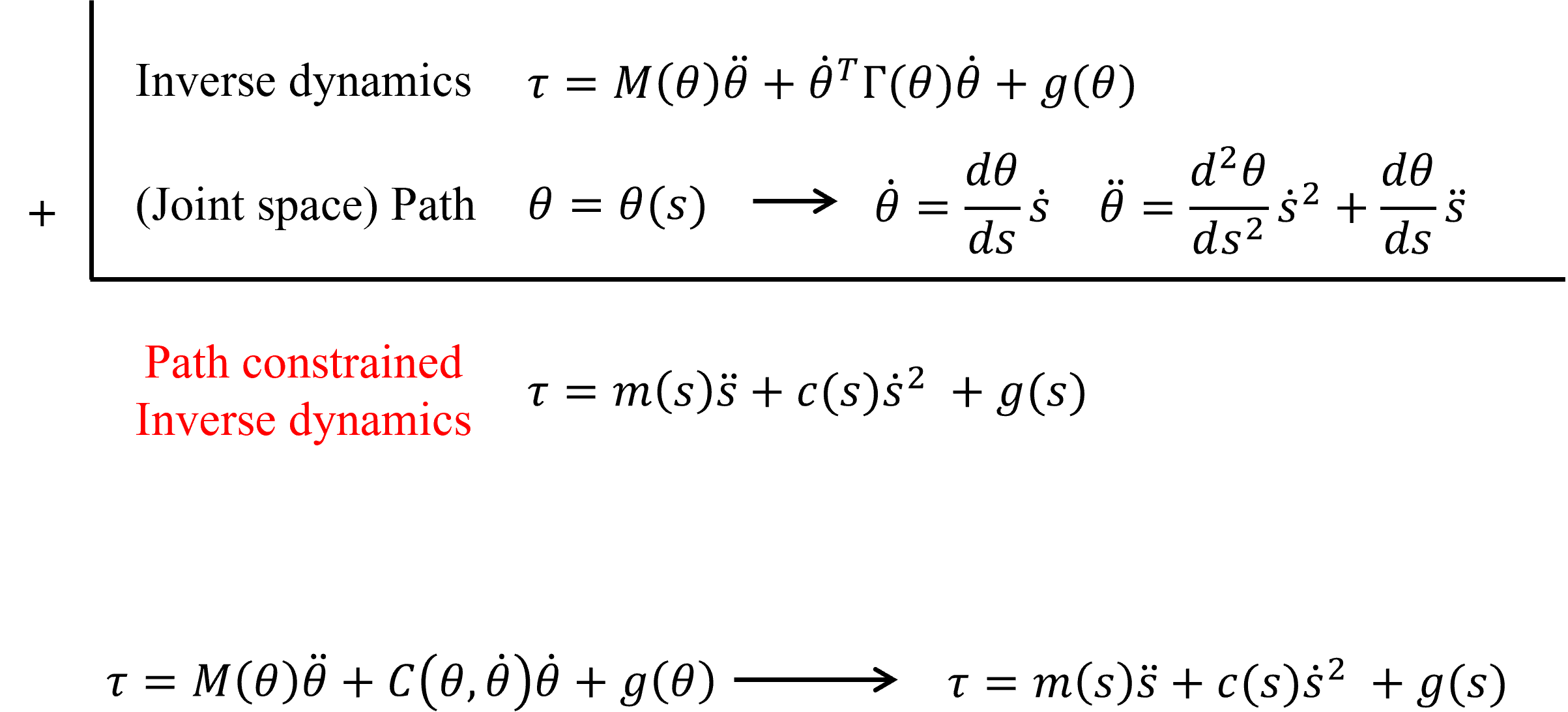
●The robot's inverse dynamics equation when the robot follows the given path $\theta(s)$
●Of course the joint torque should stay within the torque limit. $\tau_{min}\le\tau=m(s)\ddot{s}+c(s)\dot{s}^{2}+g(s)\le\tau_{max}$
Actuator constraint of time-scaling
$\tau_{min}\le m(s)\ddot{s}+c(s)\dot{s}^{2}+g(s)\le\tau_{max} \longrightarrow \color{Red} L(s,\dot{s}) \le \ddot{s} \le U(s,\dot{s})$
●From the path-constrained inverse dynamics, we can derive the state-depending acceleration limit of the time-scaling from the torque limit and the path.
●This represents that the capable range of $\ddot{s}$ when the state($s,\dot{s}$) is given
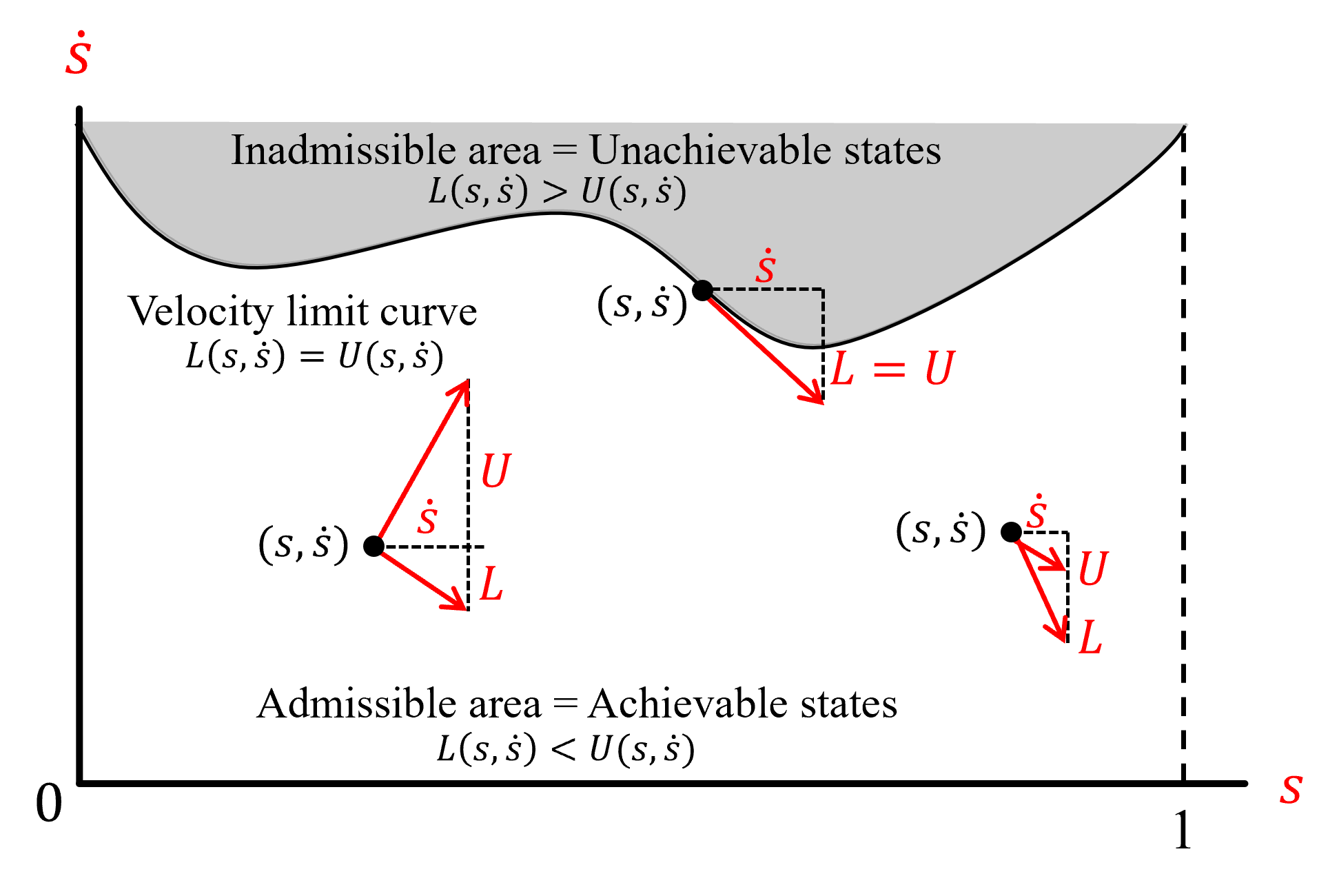
●A state ($s,\dot{s}$) where $U(s,\dot{s})\lt L(s,\dot{s})$ is an unachievable state with the given torque limit and path.
$(s,\dot{s})$ phase plane
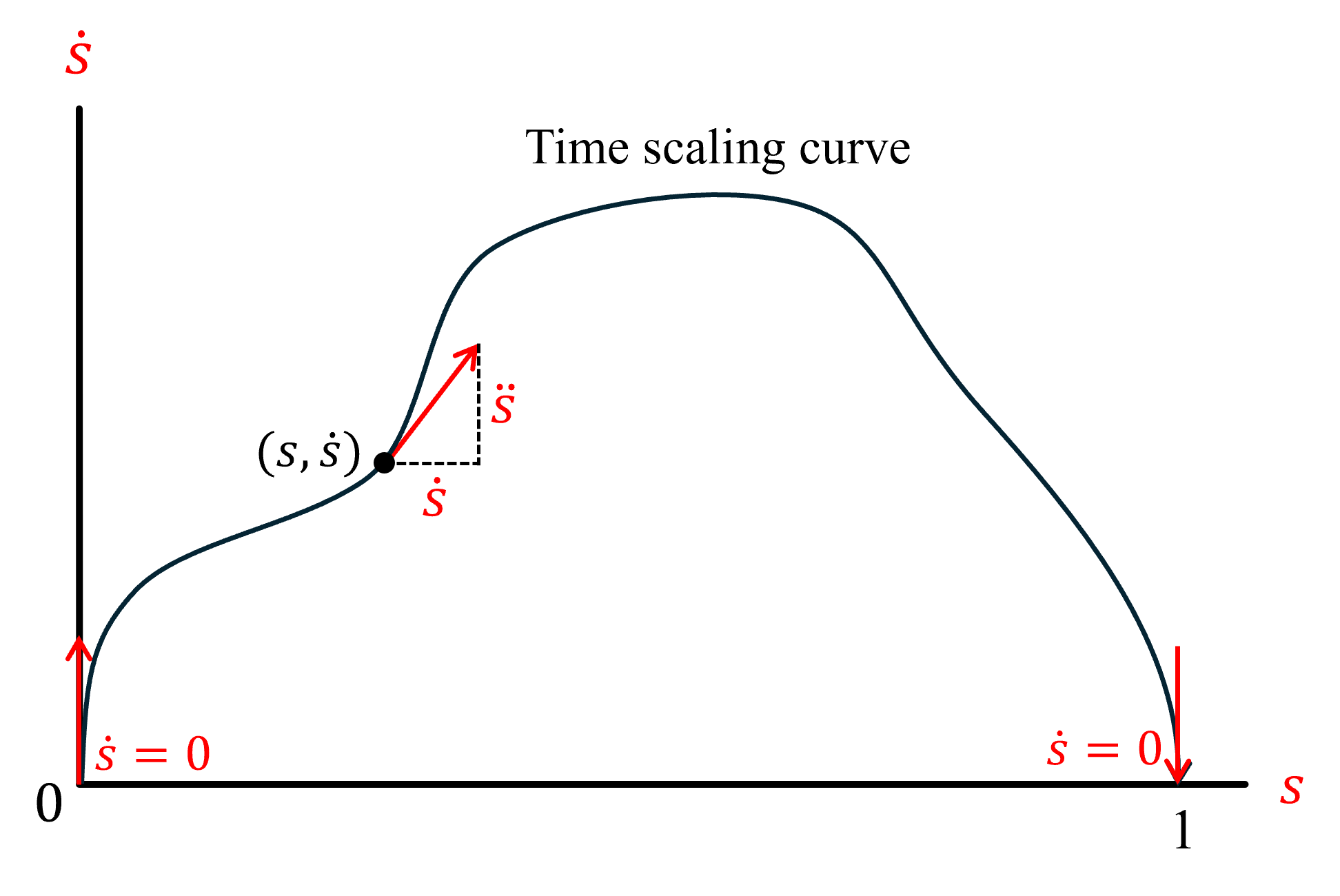
●A curve on the plane shows a time scaling.
●For the time-optimal time scaling problem, curves must start at (0,0) and end at (1,0).
●The larger the area below the curve, the shorter the time of the motion(T).
+)$T=\int_{0}^{T}1dt=\int_{0}^{1}\frac{dt}{ds}ds=\int_{0}^{1}\dot{s}^{-1}(s)ds$
●A tangent vector at the point of the curve represents $(\dot{s},\ddot{s})$, so it's direction contains the acceleration information.(Not good enough)
●Tangent vectors at (0,0) and (1,0) must be perpendicular to the s-axis since $\dot{s}(0)=\dot{s}(1)=0$.
●We can draw a cone at a point $(s,\dot{s})$ and it represents the possible $\ddot{s}$ range(actuator constraint) at that state $(s,dot{s})$
●So the cone contains the information about the robot's torque limit and the path. (My own explanation)
●There is an area where $U(s,\dot{s})\le L(s,\dot{s})$, so the time scaling curve cannot pass through it. (Velocity limit curve)
●The time-optimal time-scaling problem comes down to finding a possible time-scaling curve with the largest area.
●If there isn't any velocity limit, a curve with starting maximum acceleration $U$ followed by a curve of minimum acceleration $L$ is the time-optimal curve. (Bang-bang time scaling)

●If there is a velocity limit and the bang-bang curve intrudes into the inadmissible area, the time-scaling algorithm is needed to find the optimal curve.
※Chapter test와 Module test 일부 문제 완벽하게 이해 못함. 추후 추가 공부 필요. 특히 module test 2번 문제...
========================================================================
정확한 정보 전달보단 공부 겸 기록에 초점을 둔 글입니다.
틀린 내용이 있을 수 있습니다.
틀린 내용이나 다른 문제가 있으면 댓글에 남겨주시면 감사하겠습니다. : )
========================================================================
'공부 > Modern Robotics' 카테고리의 다른 글
| [Modern Robotics] 강좌 3: 로봇 동역학 #4 (0) | 2024.12.31 |
|---|---|
| [Modern Robotics] 강좌 3: 로봇 동역학 #3 (0) | 2024.12.11 |
| [Modern Robotics] 강좌 3: 로봇 동역학 #2 (1) | 2024.12.11 |
| [Modern Robotics] 강좌 3: 로봇 동역학 #1 (0) | 2024.12.06 |
| [Modern Robotics] 강좌 2: 로봇 기구학 #2 (0) | 2024.12.04 |


