
Open chain dynamics in the Task space: Given $\mathcal{V}_{tip}$and $\theta$, the relation between $\dot{\mathcal{V}}_{tip}$ and $\mathcal{F}_{tip}$ (※$\mathcal{F}_{tip}$ is the wrench generated by the robot movement, not an external force)
$\tau=M(\theta)\ddot{\theta}+h(\theta,\dot{\theta})\longrightarrow \mathcal{F}_{tip}=\Lambda_{tip}(\theta)\mathcal{\dot{{V}}_{tip}}+\eta_{tip}(\theta,\mathcal{V})$
End effector mass matrix $\Lambda_{tip}(\theta)$ : Refer to [강좌3, 로봇 동역학 #1]
$\eta_{tip}(\theta,\mathcal{V})=J^{-T}h(\theta,\dot{\theta})-\Lambda(\theta)\dot{J}J^{-1}\mathcal{V}=J^{-T}h(\theta,J^{-1}\mathcal{V})-\Lambda(\theta)\dot{J}J^{-1}\mathcal{V}$
●Derived by using $\mathcal{V}_{tip}=J_{tip}(\theta)\dot{\theta}$ and $\dot{\mathcal{V}}_{tip}=\dot{J}_{tip}(\theta)\dot{\theta}+J_{tip}(\theta)\ddot{\theta}$
●Note that Jacobian $J$, twist $\mathcal{V}$, wrench $\mathcal{F}$ all are expressed in end effector frame {tip}
●Cannot replace $\theta$ with end effector configuration $X$ since the open chain inverse kinematics can have multiple solutions.
Friction term $\tau_{fric}$: The torque generated by the motor's friction(gears, bearing).
●The previous open chain dynamics didn't account for the friction. Therefore, to model precisely, torques by friction should be included.
●Generally there are two terms: Static friction which is constant and Viscous friction which is proportional to $\dot{\theta}$
I'll skip section 8.7 Constrained Dynamics since I haven't fully understood the chapter....
DC (servo) motor basics
●Torque is proportional to current with the torque constant: $\tau=k_{t}I$
●Simply put, torque and angular velocity have a linear relation: $\omega=-\frac{R}{k_{t}^2}\tau+\frac{V}{k_{t}}$ for constant $V$ > Speed-torque curve of the DC motor.

●No-load speed $\omega_{0}$: Maximum motor speed without making any torque.
●Stall torque $\tau_{stall}$: Maximum motor torque without rotating.
●The lower the voltage, the lower the stall torque and no-load speed.
●Below the curve represents the continuous operating region, $(\tau_{cont},\omega_{cont})$

●The gear system is used to achieve higher torque.
●For the geared DC motor with gear ratio $G$ and efficiency $\eta$, speed becomes $\frac{1}{\eta G}$ times and torque becomes $\eta G$ times.
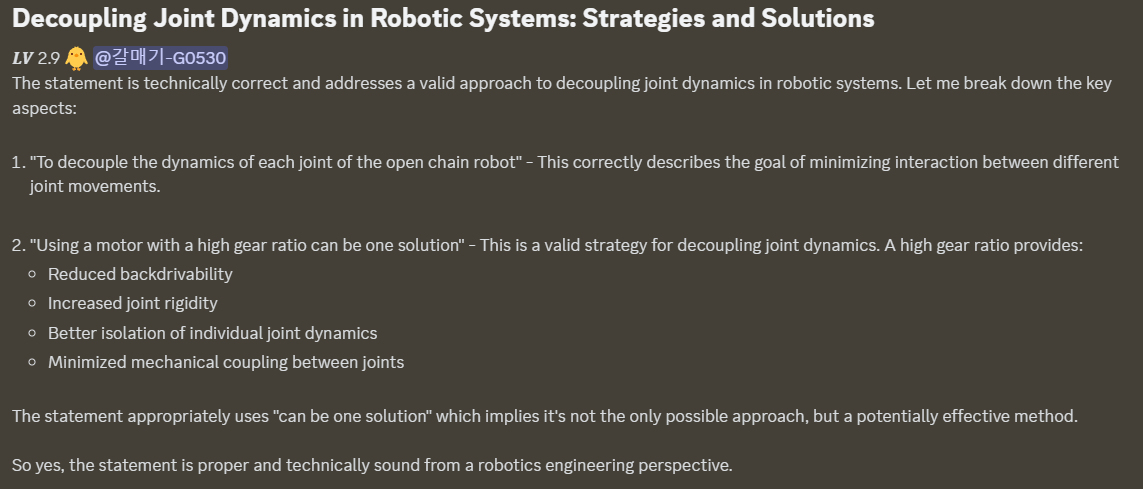
●To decouple the dynamics of each joint of the open chain robot, using a motor with a higher gear ratio can be a solution, as the mass matrix $M(\theta)$, which includes the motor inertia, becomes diagonalized. (My own explanation, uncertain)
========================================================================
정확한 정보 전달보단 공부 겸 기록에 초점을 둔 글입니다.
틀린 내용이 있을 수 있습니다.
틀린 내용이나 다른 문제가 있으면 댓글에 남겨주시면 감사하겠습니다. : )
========================================================================
'공부 > Modern Robotics' 카테고리의 다른 글
| [Modern Robotics] 강좌 3: 로봇 동역학 #5 (0) | 2025.01.03 |
|---|---|
| [Modern Robotics] 강좌 3: 로봇 동역학 #4 (0) | 2024.12.31 |
| [Modern Robotics] 강좌 3: 로봇 동역학 #2 (1) | 2024.12.11 |
| [Modern Robotics] 강좌 3: 로봇 동역학 #1 (0) | 2024.12.06 |
| [Modern Robotics] 강좌 2: 로봇 기구학 #2 (0) | 2024.12.04 |


