그동안 로봇공학 기초를 제대로 공부하지 않았던 거 같아서 이번에 기초를 다지고자 Modern Robotics 강의를 신청했습니다.
Coursera에서 무료로 수강할 수 있고 동영상과 교재는 모두 한국어 자막과 번역본이 있습니다. 저는 영어에 익숙해지기 위해 영어 자막+원서로 수강했습니다.
24/11/27 추가) Coursera에 [현대 로봇공학]강의와 [Modern Robotics]강의가 둘 다 있습니다. 둘은 같은 강의이며 어느 쪽을 선택해도 영어 수강/한국어 수강이 가능합니다. 하지만 [현대 로봇공학] 강의를 신청해야지만 각 모듈 마지막에 있는 Graded assignment와 Coppelia sim을 이용한 project 과제를 무료로 할 수 있습니다. [Modern Robotics]로 신청하면 유료버전에서만 과제를 제공하니 가능하면 [현대 로봇공학]으로 수강신청하는 것을 추천합니다.
강의는 Northwestern 대학교의 Kevin Lynch 교수님이 진행하며, 교재는 Kevin Lynch 교수님과 서울대학교의 박종우 교수님이 집필 하셨습니다.
블로그에는 정의나 중요한 개념 위주로 간단하게 정리한 내용을 올릴 예정입니다.
+)이번 Modern Robotics 정리글에서는 Latex를 연습 겸 적극 사용할 예정입니다. 또한 가능한 영어를 사용할 예정입니다.
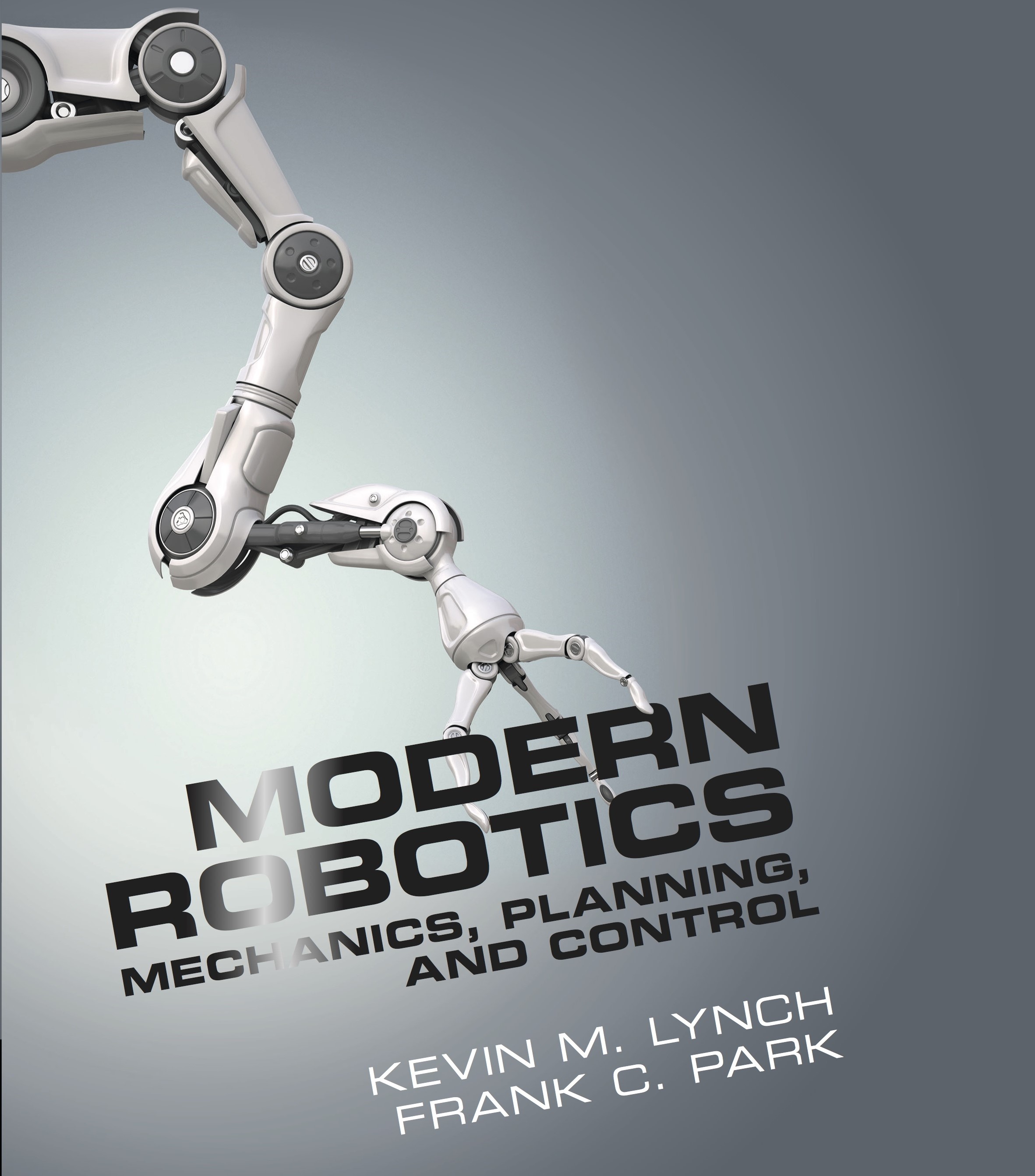
https://www.coursera.org/learn/modernrobotics-course1-ko
현대 로봇공학, 강좌 1: 로봇 동작의 기초
Northwestern University에서 제공합니다. 로봇이 어떻게 움직이는지 궁금하신가요? 로봇공학 커리어에 관심이 있으신가요? 로봇공학의 모든 하위 분야에서 사용되는 기초적인 수학적 모델링 기법을
www.coursera.org
Configurations: a specification of the position of all points of the robots
●Only a real valued, continuous variable can be configuration.
ex)Sides of a coin{Head, Tail} is discrete value > Not a configuration
●A cose of the rigid body spatial configuration: $x,y,z,\psi,\theta,\varphi$ (Rotation with the Euler angles)
Degrees of freedom(DOF): the smallest number of real-valued coordinates needed to represent its configuration
Configuration space(C-space): For a N dof robot, the N-dimensional space containing all possible configurations
ex)C space of a door on wall: θ [0, π]
●Topology of C-space is independent of how we represent it's spatial position in the space. It's just a representation of how C-space looks like.
●Some C-space can be made with the Cartesian product of $\mathbb{E}$(or $\mathbb{R}$), $\mathbb{S}$, $\mathbb{T}$
●Topology of joints
| System | Topology | Note | Example |
| Line | $$\mathbb{E, R}$$ | closed line: $[a,b]\in \mathbb{R}$ | prismatic joints |
| Circle | $$\mathbb{S}$$ | a single revolute joint | |
| Cartesian 3D space | $$\mathbb{R^3}$$ | rigid body spatial position | |
| Sphere surface | $$\mathbb{S^2}$$ | the earth surface | |
| $$\mathbb{S\times S=T^{2}}$$ | Torus surface, $ \mathbb{S} ^{2} \neq \mathbb{T} ^{2}$ | 2-DOF serial robots | |
| $$\mathbb{R^{3}\times S^{2}\times S}$$ | rigid body in 3D space (position + orientation) |
||
| ... | ... |
※ $\mathbb{S}^n$하고 $\mathbb{T}^n$이 아직 헷갈림, 추가 이해 필요
Grubler's(Kuzbach's) formula: Used for calculate a mechanism's DOF that consist of rigid links and joints.
$$\begin{align}
\text{system's dof}=\text{rigid body freedoms}-\text{joint constraints} \\
=m(N-1)-\sum_{i=1}^{J}c_{i}\\
=m(N-1-J) + \sum_{i=1}^{J}f_{i}\\
\end{align}$$
$$m=3\text{ (Planar) }or \text{ 6 (Spatial)}, \text{ N = # of links}, \text{J = # of joints} $$
$$c_{i}\text{= a joint's constraint },f_{i}\text{= a joint's freedom}$$
●$f_{i}+c_{i}=m$
●Only holds if all joint are independent (Note the parallel link systems)
●Need to consider multiple intersection on a sigle point
●Need to consider whether some joints are redundant
Explicit representation: A choice of n-parameter for n-dimensional space
●Minimum parameters are needed to represent
●Singularity problem (Not always but commonly)(Especially for velocity)
●e.g., Euler angle(3) (spatial orientation)
Implicit representation: Using more parameters for n-dimensional space with some constraints
●$\text{dof = parameters - constraints}$
●No sigularity problem
●e.g., Rotation matrix(9-6), Quaternion(4-1), Exponential coordinate(4-1) (spatial orientation)
*(9-6) means 9 parameters and 6 constraints
Pfaffian constraints: Velocity constraints of systems that can be expressed in the form of $A(q)\dot{q}=0$.
●Two types: Integrable and Nonintegrable
Holonomic constraints: Constraints, expressed in equations, reduce the dimension(freedom), defining allowable configurations of robot system.
●Holonomic constraints of the form $g(q)=0$ can be differenciated wrt. time $t$ and then we gets $A(q)\dot{q}=0$, the Pfaffian constraints(integrable).
●Reduce both configuration and velocity dimensions.
Nonholonomic constraints: Pfaffian constraints that is not integrable. Nonintegrable velocity constraints.
●Reduce velocity dimensions but doesn't reduce configuration dimensions.
Task space: A space in which robot's task can be expressed naturally.
●Independent of the robot mechanism.
Workspace: A space in which a robot's end effector can reach.
●Independent of the task.
●The robot's end effector cannot reach some points in the task space.
●The robot's end effector can reach every points in the task space.
========================================================================
정확한 정보 전달보단 공부 겸 기록에 초점을 둔 글입니다.
틀린 내용이 있을 수 있습니다.
틀린 내용이나 다른 문제가 있으면 댓글에 남겨주시면 감사하겠습니다. : )
========================================================================
'공부 > Modern Robotics' 카테고리의 다른 글
| [Modern Robotics] 강좌 3: 로봇 동역학 #2 (1) | 2024.12.11 |
|---|---|
| [Modern Robotics] 강좌 3: 로봇 동역학 #1 (0) | 2024.12.06 |
| [Modern Robotics] 강좌 2: 로봇 기구학 #2 (0) | 2024.12.04 |
| [Modern Robotics] 강좌 2: 로봇 기구학 #1 (0) | 2024.11.29 |
| [Modern Robotics] 강좌 1: 로봇 동작의 기초 #2 (0) | 2024.11.25 |


